|
||
20. Swollen Kamacite lamellae |
| Listing of Structures |
| Back...Next |
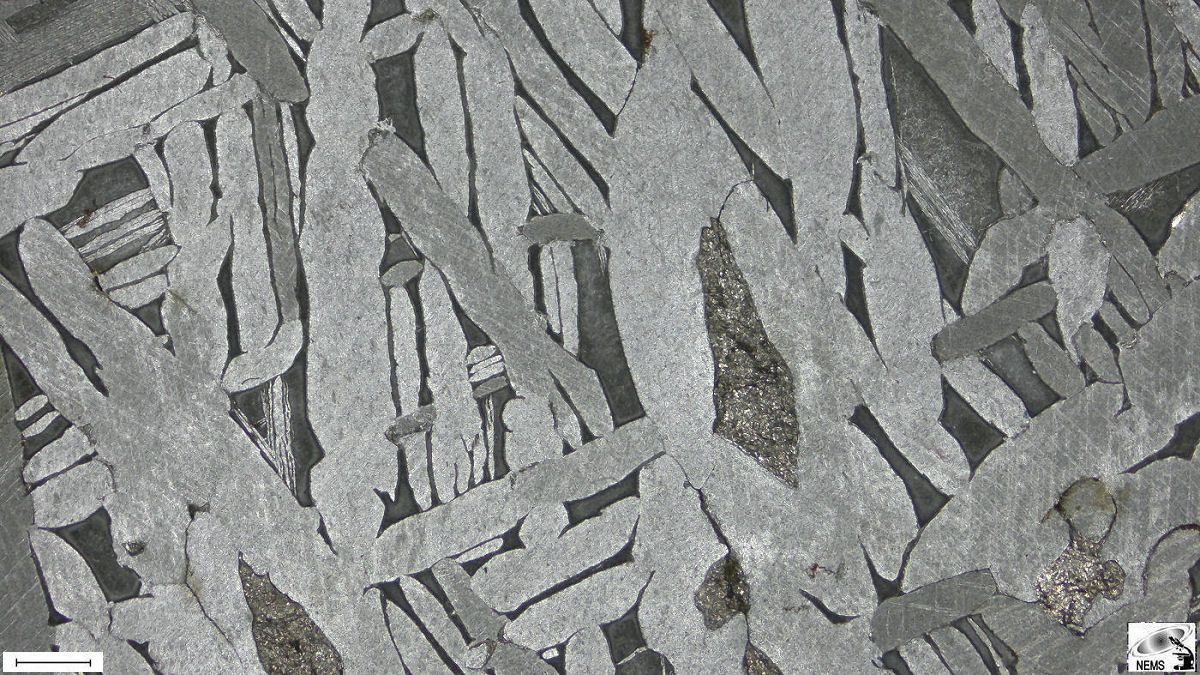
| Meteorite - Yarovoye, IIIAB Iron, fine octahedrite . |
|
| Figure 1. |
| Swollen kamacite lamellae in the Yarovoye IIIAB iron meteorite (fine octahedrite). Scale bar=1 mm. |
| Formation of Kamacite Lamellae In iron meteorites, kamacite lamellae (α-FeNi) are classic secondary structures that develop during extremely slow cooling in the parent body’s interior following primary crystallization of the molten Fe-Ni core. This exsolution process occurs over millions of years as the alloy cools through the two-phase (γ-α) field of the Fe-Ni phase diagram. Taenite (γ-FeNi) decomposes, and kamacite nucleates and grows along preferred crystallographic orientations, producing the characteristic Widmanstätten pattern. Lamellae thickness is a key indicator of cooling rate: finer octahedrites (e.g., <0.5 mm bandwidth) generally record faster cooling than coarser varieties. Swollen Kamacite lamellae “Swollen kamacite lamellae” describe unusually thick, bulbous, or morphologically irregular kamacite bands that deviate from the straight, parallel geometry typical of equilibrium Widmanstätten growth. These features arise from several factors: • Local variations in cooling rate • Elevated concentrations of minor elements such as phosphorus (P), sulfur (S), and carbon (C), which modify Ni and Fe diffusion kinetics, nucleation density, and growth morphology • Minor perturbations during the long cooling interval. Phosphorus, in particular, partitions strongly and can depress the kamacite nucleation temperature or alter interface stability, leading to coarsening or irregular bulging of lamellae. Similar effects occur near large inclusions (e.g., troilite or schreibersite), where local chemistry gradients promote enhanced kamacite growth. Subsequent shock events can further modify these structures. Impact-induced heating and pressure may cause recrystallization, polygonization, subgrain formation, or plastic deformation of the lamellae, enhancing or overprinting the swollen appearance. Yarovoye (IIIAB, Fine Octahedrite) The Yarovoye meteorite exemplifies a fine octahedrite within the IIIAB chemical group. Its kamacite lamellae display prominent swelling in localized regions (Figure 1), consistent with moderate cooling rates typical of IIIAB irons combined with minor elemental heterogeneities. Such textures illustrate the sensitivity of Widmanstätten development to both primary cooling conditions and later perturbations. Broader Significance Detailed morphometric analysis of kamacite lamellae—including bandwidth statistics, swelling indices, and associated plessite or inclusion relationships—enables refined cooling-rate estimates and reconstruction of parent-body thermal histories. In ungrouped or anomalous irons, swollen lamellae may signal more complex formation pathways. Combined metallographic, microchemical, and isotopic studies continue to refine models of asteroidal core differentiation and collisional evolution. |
| References
• Buchwald, V. F. (1975). Handbook of Iron Meteorites. University of California Press. (Core reference — describes swollen lamellae in multiple irons, including IIIAB-related examples and phosphorus effects on morphology.) • Yang, J. & Goldstein, J. I. (various papers, e.g., 2005). Fe-Ni-P phase diagram applications and cooling rate studies. Key for nucleation temperature, bandwidth, and how P influences kamacite growth/swelling. • Olsen, E. J. et al. (1999). “The phosphates of IIIAB iron meteorites.” Meteoritics & Planetary Science. Discusses high phosphate abundance in IIIAB, local chemistry gradients, and their role in modifying kamacite textures near inclusions. • Breen, J. P. et al. (2016). “Variations in impact effects among IIIE iron meteorites.” Meteoritics & Planetary Science. Explicitly notes coarser/swollen kamacite bands in IIIE (structurally/chemically near IIIAB) and links to shock/thermal perturbations. • Wasson, J. T. (various, e.g., 1999) and Chabot, N. L. (e.g., 2021 revised trapped melt model for IIIAB). Chemical fractionation, cooling rates (~ tens of K/Myr for IIIAB), and parent-body history. • General shock metallurgy: Works by Stöffler et al. or Buchwald on deformation, recrystallization, and polygonization in shocked irons (common in IIIAB). |
| |
| Listing of Structures |